Ninja Arashi
- 4.6
- Rating
- 100.00M
- Installs
- Free
- Price

 Analysis by App-foxy
I first noticed Ninja Arashi because it looks much harsher than most mobile adventure games. Its black-and-white shadow artwork gives every screen a tense, almost silent feeling, and the controls are built around quick movement rather than long explanations. After spending time with it, I found a game that understands a simple mobile truth: the best session often begins with one careful jump, turns into a string of risky decisions, ends in a mistake, and immediately makes me want to try the same section again.
Created by Black Panther, this is a free adventure game with a clear action-platforming foundation and light role-playing touches. It has attracted more than 100 million installs and holds a 4.6 average from roughly 693 thousand ratings, which matches my impression that its basic loop is easy to understand even when the later execution becomes demanding. The Teen content rating is worth noting, especially for younger players or parents choosing games for a shared device.
How the first action sets the tone
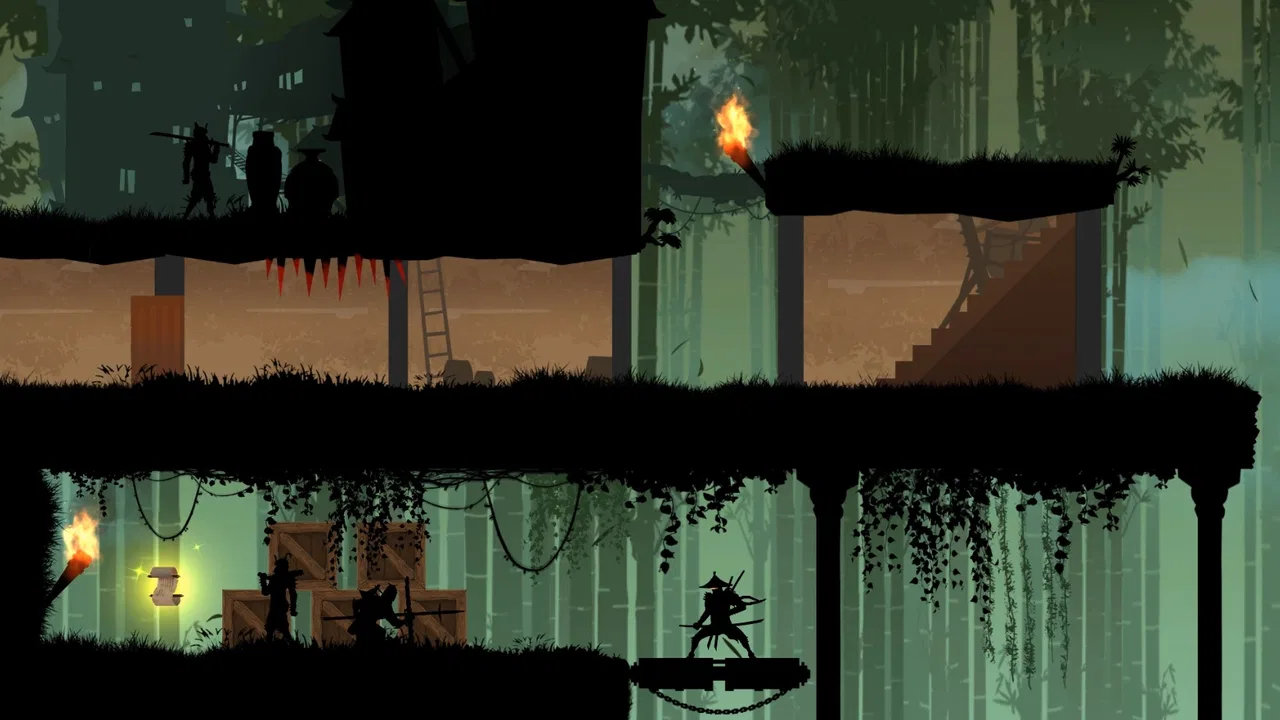
The opening movement tells you what kind of game this is. You guide a ninja through compact platforming spaces, watching for gaps, hazards, enemies, and the timing needed to move safely through each encounter. The black shadow-art presentation is not just decoration. It keeps the screen visually clean, so the important question is usually where to move next and when to commit.
You May Also Like

 AccuWeather: Weather Radar
AccuWeather Review: A Quick, Clear Forecast for Everyday Decisions
For everyday plans, the best forecast is the one you can understand quickly. AccuWeather makes rain timing, radar, and local conditions easy to act on, with a few trade-offs.

 Hill Climb Racing
Why Hill Climb Racing Still Turns Crashes Into One More Run
A tiny car, a bumpy hill and one more upgrade: Hill Climb Racing keeps resurfacing because its simple chaos makes every near-miss feel personal.

 AliExpress - Shopping App
AliExpress Makes Global Shopping Feel Personal, but Shoppers Bear the Risk
AliExpress turns a global marketplace into a pocket-sized discovery engine. Its reach is useful, its shopping loop compelling, and its trade-offs easy to miss.

 Lords Mobile: Kingdom Wars
Lords Mobile Is a Kingdom-Building Routine, Not a Quick Match
A case-by-case verdict on the building, battles, device demands, and social commitments that make Lords Mobile rewarding for some players and exhausting for others.

 PDF Scanner app - TapScanner
TapScanner Makes Paperwork Easier to Capture, Check, and Share
TapScanner makes scanning with a phone feel less like a rescue operation and more like a dependable step in getting work done. Its capture tools are useful, though not flawless.

 Block Blast!
 Shows How Much a Puzzle Game Can Leave Out
A quiet grid game shows why puzzle players increasingly value instant clarity, repeatable skill and low-pressure play—and where the genre still needs to catch up.
More From Our News Desk
View All News


I like that the game does not need a complicated premise to make the first few minutes work. The appeal comes from controlling a fragile character in a dangerous environment. A jump that looks routine can become a problem if I rush it, while an enemy that seems manageable can punish a careless approach. That creates immediate attention without requiring a long tutorial or a large collection of systems to learn.
The controls feel most comfortable when I treat each movement as a deliberate action instead of holding a direction and hoping for the best. This is especially important on a phone, where a small mistake can come from my thumb as easily as from the level design. I recommend playing with the device held steadily and keeping the screen free from accidental touches. On a short commute, that small bit of preparation makes the difference between a satisfying attempt and an irritating one.
The game’s adventure identity comes from moving through dangerous spaces rather than simply clearing isolated fights. Platforming remains the main language, but the RPG elements give progress a little more weight. I am not only trying to survive the next obstacle; I am also thinking about how improvement and collected rewards can help me approach future sections with more confidence.
Movement is the first real test
The most useful early habit is to stop treating every visible opening as an invitation to move immediately. I found better results by pausing for a moment, reading the arrangement of platforms, and deciding whether the safest route is also the quickest. That tiny delay improves the entire experience because it changes the game from frantic tapping into controlled risk.
This approach also exposes one of the game’s limitations. Players who prefer forgiving platformers may find the early mistakes too costly, particularly when they are still learning the timing. Ninja Arashi is not designed as a relaxed background game. It asks for attention, and its shadowy visual style can make some hazards less obvious until I have already learned the pattern.
That makes it a poor choice for someone looking for a completely casual game to play while watching television. It works much better when I can give the screen my full attention for a few minutes. In return, the game gives each successful movement a clear sense of ownership: I survived because I read the situation correctly, not because the level quietly carried me forward.
The feedback rhythm: action, mistake, adjustment
The strongest part of the experience is the feedback rhythm. I act, the game quickly shows whether that decision worked, and a mistake usually teaches me something useful about the space. The cycle is easy to recognize: move through a section, encounter danger, fail or continue, remember the problem, and begin again with a better plan.
That rhythm is why the game can feel intense without needing a huge amount of content on screen at once. A single jump can contain several decisions. I need to judge distance, choose a moment, manage my position after landing, and prepare for whatever follows. When I succeed, the reward is not only progress. It is also the immediate confirmation that my timing has improved.
Combat fits into this same rhythm. Enemies are not merely interruptions between platforms; they change how I approach the next few seconds. A rushed attack can leave me exposed, while an overly cautious approach can make the section feel slower and more awkward. The game encourages a balance between movement and confrontation, which is more interesting than simply running from everything or attacking everything on sight.
One practical tip is to treat failed attempts as short scouting runs. Instead of becoming frustrated by the loss, I try to identify one specific cause: a jump started too early, an enemy approached from the wrong position, or a route chosen without enough room to recover. This makes the next attempt purposeful. It also prevents the common mobile-game habit of repeating the same action with the same timing and expecting a different result.
Why the visual style helps and hurts
The shadow-art presentation gives the game a distinctive personality. Dark silhouettes and restrained backgrounds make the ninja feel like part of a dangerous, almost dreamlike world. Compared with brighter platformers that use colorful scenery to signal every object, this style feels more focused and dramatic.
There is a trade-off, though. Strong contrast does not always mean perfect readability. In a fast section, a dark object against a dark background can demand more attention than a player expects. I sometimes had to slow down simply to understand the shape of the route. That is not necessarily a flaw, because the atmosphere depends on the style, but it means players who value instant visual clarity may prefer a more colorful alternative.
The audio and visual feedback work best when I am actively engaged. A successful attack or carefully timed movement feels meaningful because it breaks the tension of the surrounding scene. The presentation would not have the same effect if the game were built around constant spectacle. Its restraint gives small victories room to matter.
Rewards that give another attempt a purpose
Progression is where the role-playing influence becomes useful. The game does not rely only on my reflexes; it gives advancement a place in the overall loop. Completing sections and collecting rewards makes the next attempt feel connected to the previous one, even when I fail before reaching the end of a difficult passage.
I appreciate this because pure platforming can sometimes make failure feel final. Here, the reward structure gives me a reason to return beyond pride. I can improve my understanding of the level while also building toward a stronger run. That combination is especially helpful during a longer play session, when repeated mistakes would otherwise begin to feel empty.
The free entry point makes it easy to test whether this style suits me. There are in-app purchases priced from $0.99 to $1.99 per item, so anyone who prefers to spend nothing can begin without paying, while optional purchases are available for players who want them. I would still recommend deciding on a personal spending limit before starting. A game built around repeated attempts can make a small purchase feel tempting precisely when I am frustrated by a difficult section.
The reward loop is most satisfying when I use it to support better play rather than replace it. If I am relying on upgrades or purchases to avoid learning the route, the central challenge loses some of its appeal. The game is at its best when progression gives me a little more confidence while timing and observation remain important.
A useful way to manage progress
My preferred workflow is to play until I have learned one meaningful lesson, then stop before frustration turns the session into random tapping. On the next visit, I start by applying that lesson rather than immediately chasing the farthest point reached. This makes the progression feel steady and keeps the reward system connected to skill.
This is also where the game suits different players in different ways. Someone who enjoys mastering repeated challenges will probably find the structure motivating. Someone who wants constant new mechanics and a rapidly changing world may find the repetition too narrow. The RPG layer adds direction, but it does not transform the game into a deep character-management adventure.
That distinction matters when comparing it with usual alternatives. A conventional endless runner is easier to start because its movement is often more automatic, but it may offer less deliberate control over each obstacle. A large story-driven adventure can provide richer exploration and dialogue, yet it demands more time and storage attention than a focused platformer. Ninja Arashi sits between those extremes: more intentional than a quick runner, but more compact and mechanically direct than a sprawling adventure.
Resetting after failure without losing momentum
The reset is central to the experience. When an attempt ends, I am not left wondering what the game wanted from me. The failure points back toward a specific decision, and that clarity makes restarting feel reasonable. The next session begins because the previous one revealed something I can use.
This is the kind of reset that works well in everyday situations. Imagine having ten minutes before a meeting or while waiting for a friend. I can enter a section, make a few careful attempts, and leave with a better understanding of the route even if I do not finish it. The game does not require me to commit to a long uninterrupted evening before it becomes worthwhile.
At the same time, I would not describe every session as relaxing. The repeated restart structure can become tiring if I am playing when distracted, tired, or impatient. A missed jump feels more annoying when I know I could have avoided it by concentrating. For that reason, I use it as a focused break rather than as a soothing game for the end of a stressful day.
The version I reviewed is 1.9.3, and it requires Android 6.0 or later. That makes the game accessible on a broad range of Android devices, although the exact feel will still depend on the phone’s screen, touch response, and performance. I would check the device requirement before downloading on an older handset, particularly if the game is intended for a child’s phone or a secondary device.
Who should skip it
I would skip this game if I wanted a gentle platformer with generous recovery, a large open world, or a story that carries the experience from scene to scene. Its presentation is atmospheric, but the main reason to play is the action loop. Players who dislike repeating a section after a mistake may also struggle to enjoy its structure.
I would also hesitate to recommend it to younger children despite the simple controls. The Teen rating means parents should consider whether the tone and action are appropriate before handing it over. For older players, the rating is a useful reminder that this is not designed as a preschool-friendly adventure.
On the other hand, I would recommend it to anyone who likes learning through failure. It is particularly suitable for players who enjoy compact challenges, dark visual design, and the feeling of turning a previously impossible sequence into a reliable one. The free price makes that decision easy: try the opening, see whether the controls feel natural, and judge the repetition for yourself before considering any purchase.
The complete loop and my recommendation
The complete loop is simple but effective. I begin with a movement decision, receive immediate feedback from the environment or an enemy, earn progress when the attempt works, and reset when it does not. The reason to start another session is the possibility of returning with better timing, a clearer route, and a little more progression behind me.
That loop is more important than the individual features. The shadow-art style attracts attention, and the RPG touches add a sense of direction, but the game succeeds because each attempt has a readable consequence. It rarely feels as though I am waiting for the game to become interesting. The interesting part is the next decision.
There are clear limitations. The visual darkness can reduce readability, repeated attempts may wear down players who want constant novelty, and the action demands more concentration than a typical idle or casual game. The progression also works best as support for platforming skill, not as a replacement for it. Those are meaningful trade-offs rather than minor footnotes.
Still, I think Ninja Arashi is a strong recommendation for Android players who want a focused adventure game with a serious atmosphere and a satisfying retry cycle. Black Panther keeps the concept compact enough for short sessions while giving successful movement enough weight to make another attempt feel worthwhile. If you enjoy action that rewards patience, observation, and gradual mastery, I would start with the free version and see how quickly the first reset turns into “one more try.”
FAQs for Ninja Arashi
01What is the main objective of Ninja Arashi?
Ninja Arashi is an action-packed platformer where players navigate through challenging levels as Arashi, a former ninja warrior. The main objective is to rescue Arashi’s kidnapped son from the clutches of the evil demon Orochi. Players must overcome various obstacles, defeat enemies, and solve puzzles to progress through the game.
02Is Ninja Arashi free to play, or does it have in-app purchases?
Ninja Arashi is free to download and play, offering a rich experience without any upfront cost. However, it includes in-app purchases that allow players to buy items or upgrades. These purchases can enhance gameplay, but they are not necessary to complete the game. Players can choose to enjoy the full experience without spending money.
03What are the key features of Ninja Arashi?
Ninja Arashi features intuitive controls, stunning graphics, and an engaging storyline. Players can enjoy a variety of challenging levels, each with unique obstacles and enemies. The game includes an upgrade system, allowing players to enhance Arashi’s abilities. Its captivating art style and dynamic gameplay make it a standout in the platformer genre.
04Does Ninja Arashi require an internet connection to play?
Ninja Arashi is designed to be played offline, which means an internet connection is not required for gameplay. This makes it convenient for users who want to enjoy the game without worrying about connectivity issues. However, an internet connection might be needed for downloading updates or accessing certain online features.
05How does the control system work in Ninja Arashi?
Ninja Arashi employs a simple yet effective control system. Players use on-screen buttons to move, jump, and attack. The controls are responsive, allowing for precise movements crucial for overcoming the game’s challenges. The intuitive setup ensures that even new players can quickly master the mechanics and fully enjoy the action-packed experience.
Pros
- Stunning visuals and animations.
- Challenging levels with varied gameplay.
- Smooth and responsive controls.
- Engaging storyline with twists.
- Free to play with optional purchases.
Cons
- Can be difficult for beginners.
- In-app purchases can be pricey.
- Limited character customization.
- Ads can interrupt gameplay.
- Requires internet for some features.

Ninja Arashi
Gallery